Most Indian businesses that try AI automation start in the wrong place. They pick the most exciting idea, such as a chatbot for everything or an “AI agent” that will run operations, and six months later they have a pilot nobody uses. The businesses that get real value usually start with something smaller and more boring: the task that eats two hours of someone’s day, every day, and follows the same steps every time.
This guide gives you a simple way to decide what to automate first, a list of high-value starting points across sales, operations, finance and HR, and a 30-day plan to get the first workflow live.
Quick answer: Automate first the processes that are high-volume, repetitive, rule-based and already well understood, where a mistake is easy to catch and the data is already digital. In most Indian businesses that means lead capture and follow-up, after-hours call handling, invoice and payment reminders, internal reporting and answering repeat internal questions. Leave judgment-heavy work, such as pricing negotiations or hiring decisions, for later, and keep a person in the loop where errors are costly.
What is AI workflow automation?
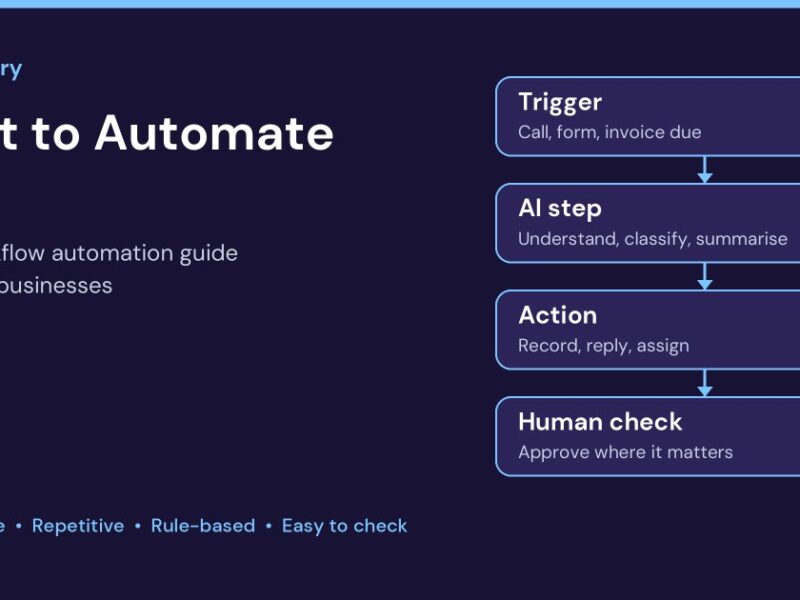
Workflow automation means a sequence of business steps runs on its own once something triggers it: a form is submitted, a call comes in, an invoice becomes due. Traditional automation follows fixed rules. AI workflow automation adds steps that need understanding, such as reading an email, classifying a request, transcribing a call in Tamil or Hindi, summarising a document or answering a question from your own data.
A simple example: a customer calls after hours. An AI voice agent answers, understands the request, captures the details, creates a record, sends a WhatsApp confirmation and assigns a callback to the right person in the morning. Four or five manual steps become one automated flow, with a person stepping in only where judgment is needed.
How to choose what to automate first: a 6-point test
Score each candidate process from 1 (low) to 3 (high) on these six questions. Start with the process that scores highest.
| Question | Why it matters |
|---|---|
| 1. How often does it happen? | A task done 50 times a day saves more than one done once a month. |
| 2. Are the steps the same each time? | Clear, repeatable steps are easy to automate reliably. |
| 3. Is the information already digital? | If data lives in registers or on paper, digitise first, then automate. |
| 4. Is a mistake easy to catch and fix? | Start where errors are low-risk, such as reminders, not where they are costly, such as payments to vendors. |
| 5. Does delay cost you money? | Slow replies to leads, missed calls and late invoices directly affect revenue and cash flow. |
| 6. Does the team already agree on how it should work? | Automating a disputed process just automates the argument. |
A process that scores 15 or more out of 18 is usually a strong first candidate. One that scores under 10 probably needs process clean-up before any automation.
Eight good first workflows for Indian businesses
1. Lead capture and first response (sales)
Enquiries arrive from the website, Facebook and Instagram ads, WhatsApp, Google campaigns and walk-ins. Automating capture into one system, with an instant acknowledgement and an assigned owner, is often the quickest win because slow first response directly costs sales. This is what ZeaCRM is built for.
2. After-hours and overflow call answering (customer service)
Calls outside office hours, or when every line is busy, are usually lost. An AI voice agent that understands the caller’s language can answer, capture the request and hand over to your team. Zea Voice answers calls 24/7 in major Indian languages.
3. Payment and invoice reminders (finance)
Reminders for due and overdue invoices follow fixed rules: send on the due date, then after 7 days, then escalate. Automating them improves cash flow without anyone having to make uncomfortable calls every morning. Businesses covered by GST e-invoicing already generate invoice data digitally, which makes this easier to connect.
4. Daily and weekly reports (management)
Many managers spend Monday morning copying numbers from different tools into one sheet. Automated reports that pull from sales, operations and finance systems remove that work and reduce copy-paste errors.
5. Answering repeat internal questions (operations and HR)
“What is our leave policy?”, “What was last month’s collection in the Salem branch?”, “Which leads are pending with this executive?” These questions interrupt senior people all day. An internal knowledge assistant such as Zea Brain gives instant answers across CRM, HR, finance and operations data, so people can find the answer themselves.
6. Task tracking and team motivation (HR and operations)
Recurring tasks, daily targets and follow-ups often slip when they rely on reminders in a group chat. Zea Play turns team tasks into XP, leaderboards and rewards, which makes completion visible and gives managers a clear view of who is on track.
7. Document and data entry (back office)
Reading purchase orders, KYC forms or delivery notes and typing them into a system is repetitive and error-prone. AI can extract the fields and send them for a quick human check before they are saved.
8. Website enquiries and bookings (marketing)
If your website collects enquiries that someone copies into a spreadsheet, connecting forms directly to your CRM and calendar is a simple, high-value fix. A website built for conversion makes every other automation more effective.
What not to automate first
- Processes nobody can explain clearly. Fix and document them first.
- High-value judgment calls. Large discounts, credit decisions, hiring and firing should stay with people, with AI only preparing information.
- Anything involving money going out. Vendor payments and refunds need human approval even when the paperwork is automated.
- Rare tasks. A task done four times a year rarely justifies the setup effort.
Off-the-shelf product or custom automation?
| Ready product | Custom workflow or software | |
|---|---|---|
| Best for | Common needs: leads, calls, tasks, internal answers | Processes unique to your business or industry |
| Time to go live | Usually faster | Longer, depends on scope |
| Fit | You adapt slightly to the product | Built around how you already work |
| Integration | Standard connections | Can connect older or in-house systems |
Many businesses use both: ready products for common workflows, and custom software development to connect them to existing systems or handle the steps no product covers.
A 30-day plan for your first automation
- Week 1: Pick and map. List five candidate processes, score them with the 6-point test and pick one. Write down every step as it happens today, including who does it and which tools they use.
- Week 2: Clean up and decide the rules. Remove unnecessary steps, agree on exceptions and decide where a person must approve.
- Week 3: Build and test. Set up the workflow, run it alongside the manual process and compare results.
- Week 4: Go live and measure. Switch over, track time saved, response time or errors, and collect feedback from the team using it.
Only move to the second workflow once the first one is running without daily fixes.
Things Indian businesses should plan for
- Languages. Customers and staff may switch between Tamil, Hindi, English and other languages in one conversation. Choose tools that handle this.
- WhatsApp and SMS first. Most customer communication happens on WhatsApp and phone calls rather than email, so automations should work on those channels.
- Data protection. The Digital Personal Data Protection Act, 2023 and its Rules apply to customer and employee data. Build consent, access control and data deletion into workflows from the start.
- Team adoption. Explain what the automation does and what it does not replace. People support tools that remove their most boring work.
Frequently asked questions
What is the first process a small business should automate?
Usually lead capture and first response, because it happens often, follows clear steps and directly affects sales. After-hours call answering and payment reminders are also strong first choices.
Is AI workflow automation only for large companies?
No. Smaller businesses often see the benefit faster because a few people handle many tasks, so removing even one repetitive task frees up a large share of someone’s day.
Will AI automation replace my staff?
For most businesses it removes repetitive work rather than roles. Staff spend less time copying data, chasing reminders and answering the same questions, and more time on customers and decisions.
How long does it take to automate a workflow?
A focused first workflow using a ready product can often go live within a few weeks. Custom integrations take longer depending on the systems involved.
Do I need clean data before automating?
You need the data for that one process to be digital and reasonably consistent. You do not need to clean your entire business data before starting.
How do I measure whether automation is working?
Measure before and after: hours spent on the task, response time, error rate, and the business result it affects, such as leads followed up or invoices collected on time.
Start with one workflow
You do not need an AI strategy document to start. You need one painful, repetitive process and a clear way to measure improvement. URL Factory builds the products and custom automation to do that for Indian businesses, from our product suite to fully custom workflows. If you want help choosing your first workflow, Contact Us.
Related reading: AI voice agents for Indian businesses: how multilingual call answering works.