
A customer in Coimbatore calls your number at 9:40 pm and starts in Tamil, switches to English for the product name and ends with a question about EMI. Your office closed at 7. In most Indian businesses that call rings out, and the customer tries the next number on the search results.
AI voice agents are built for exactly this gap. They answer the call, understand the caller in their own language and either resolve the request or pass it to your team with the details already captured. This guide explains how they work, where they fit in an Indian business, where they do not, and what to check before you put one on your main line.
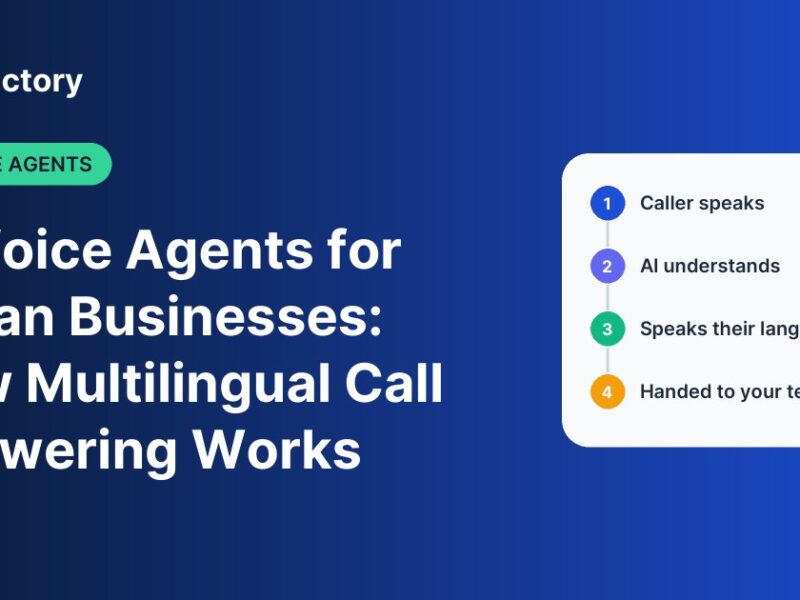
Quick answer: An AI voice agent is software that answers phone calls and holds a spoken conversation with the caller. It converts speech to text, works out what the caller wants, decides on a response using your business information, and speaks the answer back in a natural voice. Unlike an IVR menu, the caller does not press buttons. They simply say what they need, in the language they are comfortable with.
How an AI voice agent handles a call
Every call passes through the same five stages, usually within a second or two per turn:
- Listening (speech recognition). The caller’s speech is converted into text. For India, this stage has to cope with regional accents, background noise and callers who mix languages in one sentence.
- Understanding (intent and details). The system identifies what the caller wants, such as booking an appointment, checking an order or asking for a price, and picks out details like name, location and date.
- Deciding (business logic and knowledge). The agent checks the information you have given it: timings, price lists, policies, appointment slots or records in your CRM. This is where the quality of your own data matters most.
- Speaking (text to speech). The reply is converted into spoken audio in the caller’s language.
- Acting (integration and handoff). The agent logs the call, creates or updates a lead, books a slot, sends a confirmation, or transfers the call to a person along with a summary.
A voice agent is only as useful as stages three and five. A system that understands Tamil perfectly but cannot see your appointment calendar will still end the call with “someone will call you back”.
IVR and AI voice agents are not the same thing
| Aspect | Traditional IVR | AI voice agent |
|---|---|---|
| How the caller interacts | Presses keys from a fixed menu | Speaks naturally |
| Languages | Separate recorded menu for each language | Responds in the language the caller speaks |
| Unexpected questions | Cannot handle them, returns to the menu | Can answer from your business information or hand off |
| Data capture | Limited to key presses | Captures name, need, location and timing from the conversation |
| Changing the flow | Re-record prompts and rebuild the menu | Update the instructions and knowledge it works from |
| Best for | Simple routing | Enquiries, bookings, status checks and first-level support |
Why multilingual matters so much in India
An English-only phone line quietly filters out a large share of your customers. A caller who cannot explain a problem comfortably will often hang up rather than struggle. For a business serving more than one state, the practical choices have been to hire staff for each language or to accept that some callers will get a poorer experience.
The harder requirement is not the number of languages on a brochure. It is code-mixing: the everyday habit of blending Tamil, Hindi, Telugu or Kannada with English in a single sentence. When you evaluate any voice agent, test it with real mixed-language sentences from your own customers, not with clean scripted lines.
Where an AI voice agent fits in an Indian business
- After-hours and overflow calls. Enquiries that arrive after closing time or when all lines are busy get answered, recorded and queued for follow-up.
- Appointment booking and reminders. Clinics, service centres, salons and consultants can let callers book, reschedule or confirm without waiting for the front desk.
- First-level lead qualification. The agent asks the first few questions, such as requirement, budget in rupees, location and timing, so the sales team calls back with context.
- Order, delivery and service status. Routine “where is my order” and “when will the technician come” calls are answered from your system.
- Frequently asked questions. Timings, directions, documents required, fees and eligibility rarely need a human.
Where a person should still take the call
Voice AI is not the right answer for every conversation. Keep a clear path to a human for:
- Complaints and escalations where the caller is upset
- Negotiations, custom quotations and high-value sales conversations
- Medical, legal or financial advice
- Any situation where the caller asks for a person
A good deployment makes the handoff easy and passes the conversation summary to the staff member, so the caller does not have to repeat everything.
Checklist: what to verify before going live
- Language coverage that matches your callers. List the languages your customers actually use and test each one, including mixed-language speech.
- Response speed. Long pauses make callers talk over the agent or hang up. Listen to live test calls on a normal mobile network.
- Integration with your systems. Confirm it can read from and write to your CRM, calendar or order system. Otherwise it is a polite voicemail.
- Human handoff. Check how a call is transferred, what the staff member sees, and what happens when nobody is available.
- Call recording and data handling. Call recordings and transcripts contain personal data. Ask where they are stored, who can access them and how long they are kept. India’s Digital Personal Data Protection Act, 2023 sets expectations on consent and the handling of personal data, so involve whoever looks after compliance in your organisation.
- Disclosure. Let callers know they are speaking to an automated assistant and offer the option of a person.
- Total cost. Vendors price per minute, per call or per month. Estimate your monthly call minutes first, then compare on that basis, including setup and telephony charges.
- Reporting. You should be able to see how many calls were answered, resolved, transferred and dropped.
A phased rollout that limits risk
Businesses that get value from voice AI rarely switch everything over in one day. A sensible sequence is:
- Start with after-hours calls only. These calls are currently unanswered, so there is little to lose.
- Review the transcripts weekly. Note the questions the agent could not answer and add that information.
- Extend to overflow during business hours. The agent picks up only when your team is busy.
- Move routine call types to the agent. Booking, status and FAQs first. Keep sales conversations and complaints with people.
How it connects to the rest of your operations
A voice agent delivers the most when it is one part of a connected system rather than a standalone tool. At URL Factory, Zea Voice answers calls in major Indian languages around the clock. Leads it captures can flow into ZeaCRM for follow-up, and Zea Brain gives your team instant answers across CRM, HR, finance and operations data. Where a business has its own systems or unusual processes, our custom software development team builds the integrations and workflow automation around them. You can see the full range on the products page.
Frequently asked questions
What is an AI voice agent?
It is software that answers or makes phone calls and holds a spoken conversation. It understands what the caller says, replies in a natural voice, and can complete tasks such as booking an appointment or logging an enquiry.
How is an AI voice agent different from an IVR?
An IVR makes callers choose from a fixed keypad menu. An AI voice agent lets callers say what they need in their own words and language, and it can handle questions that were not part of a pre-set menu.
Can AI voice agents understand Indian languages and mixed speech?
Many can handle major Indian languages, and the better ones cope with callers who mix a regional language with English. Capability varies by product and language, so test with real sentences from your own customers before you commit.
Will an AI voice agent replace my reception or call centre staff?
In most businesses it takes over repetitive and after-hours calls so that staff can spend time on complex enquiries, sales conversations and complaints. A clear handoff to a person remains essential.
Which businesses benefit most from AI call answering?
Businesses with high call volumes, callers in several languages, or enquiries outside working hours: clinics and hospitals, real estate, education, financial services, retail, automotive service and home services.
How much does an AI voice agent cost in India?
Pricing models differ. Some vendors charge per minute, some per call and some a fixed monthly fee with a setup charge. Work out your expected monthly call minutes and ask each vendor for a total in rupees on that basis.
Is it safe to record calls handled by an AI voice agent?
Recordings contain personal data and should be treated carefully. Tell callers that the call may be recorded, limit who can access recordings, set a retention period, and check your obligations under the Digital Personal Data Protection Act, 2023 with your compliance adviser.
Start with the calls you are already missing
You do not need to automate your entire phone line to see whether voice AI works for your business. Begin with the calls nobody answers today, review what callers ask, and expand from there.
If you would like to hear how Zea Voice would handle calls for your business in your customers’ languages, Contact Us and our team will set up a walkthrough.