
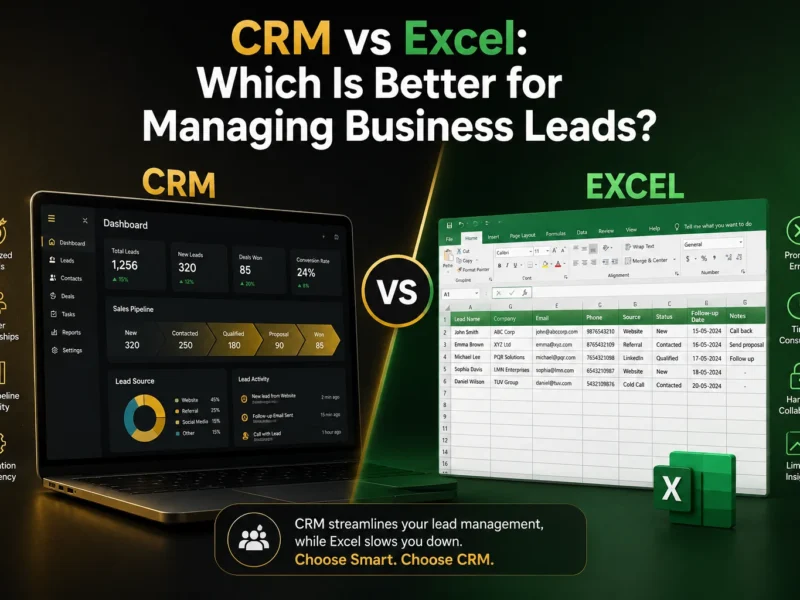
CRM vs Excel: Which Is Better for Managing Business Leads?
For many small businesses, Excel is one of the first tools used to manage customer and sales information.
A simple spreadsheet can be enough when there are only a few leads to track. You can add a customer’s name, phone number, enquiry details, follow-up date, and sales status in different columns.
But as the number of leads grows, managing everything through Excel can become difficult.
Salespeople may need to search through rows to find customer information, remember when to follow up, update lead statuses manually, and share the latest spreadsheet with other team members.
This raises an important question:
Should your business continue managing leads in Excel, or is it time to move to a CRM?
The answer depends on the size and complexity of your sales process. But understanding the differences between a CRM and Excel can help you make the right decision.
Why Do Small Businesses Use Excel for Lead Management?
Excel is familiar, flexible, and easy to start with.
A business can create a basic lead management spreadsheet within minutes.
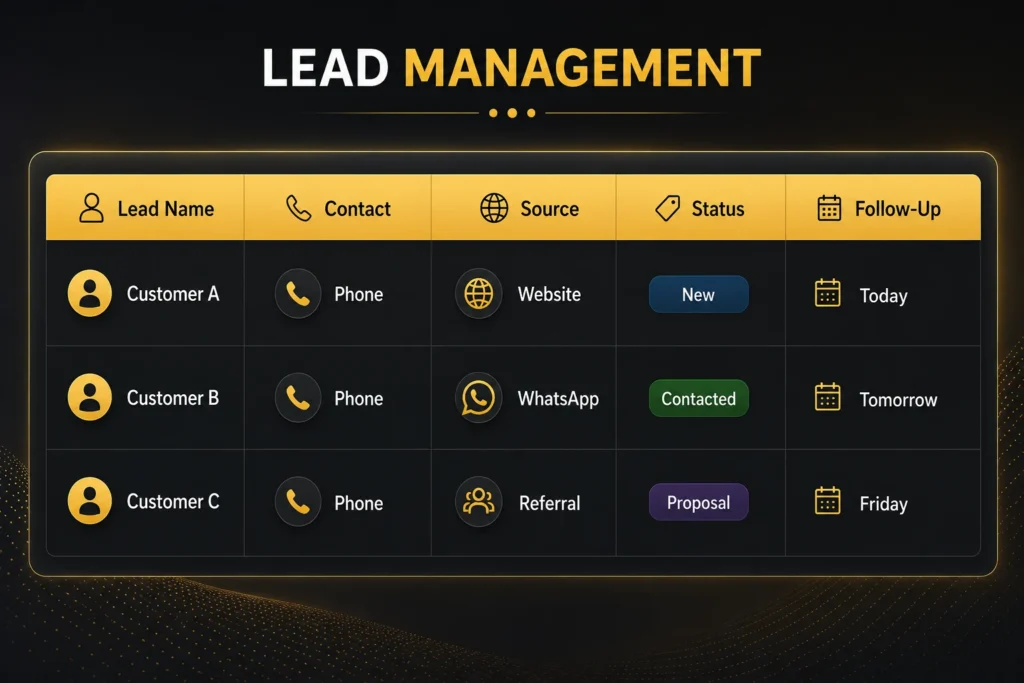
For a small number of leads, this may work perfectly well.
The problem usually appears when the business starts receiving more enquiries and multiple people become involved in the sales process.
A spreadsheet that once felt simple can gradually become difficult to maintain.
What Is a CRM?
CRM stands for Customer Relationship Management.
CRM software is designed to help businesses organize customer information, manage leads, track sales opportunities, and manage relationships throughout the sales process.
Instead of keeping customer information in rows and columns, businesses can manage leads through a structured system.
A CRM can help teams manage areas such as:
- Lead information
- Customer records
- Sales pipelines
- Follow-up activities
- Sales opportunities
- Customer communication
- Workflow automation
- Sales reporting
The exact features available depend on the CRM platform.
CRM vs Excel: What’s the Difference?
Excel is primarily a spreadsheet tool.
A CRM is specifically designed around customer and sales management.
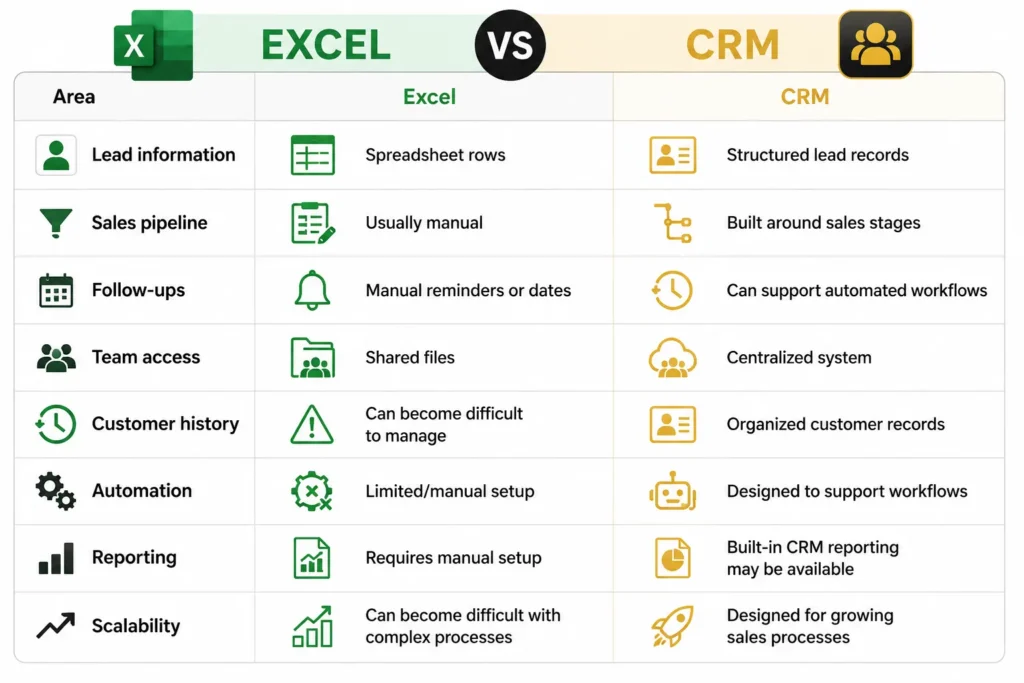
Neither option is automatically right for every business.
The better choice depends on how your business manages leads today and what your sales process requires.
1. Lead Management
One of the biggest differences is how leads are organized.
With Excel, each lead usually occupies a row.
As the spreadsheet grows, finding the right information can take more effort.
A CRM treats each lead as a record that can contain relevant customer and sales information.
This makes it easier for sales teams to work with leads based on their current status and sales stage.
For example:
New → Contacted → Qualified → Proposal → Negotiation → Won/Lost
The exact stages should reflect the business’s actual sales process.
2. Follow-Up Management
Follow-up is one of the areas where spreadsheets can become difficult.
A salesperson may enter a follow-up date in Excel, but someone still needs to check the spreadsheet and remember to take action.
A CRM can support structured follow-up workflows.
For example:
New enquiry → Initial response → Follow-up → Sales conversation → Next action
Depending on the CRM, some repetitive actions can also be automated.
This is particularly useful for businesses handling a growing number of enquiries.
The objective isn’t to remove human interaction.
It is to make sure the sales team has a clear process for managing follow-ups.
3. Sales Pipeline Management
Excel can be used to track sales stages, but businesses often need to create and maintain their own system.
A CRM is built around the concept of managing leads and opportunities through a sales pipeline.
A sales manager can potentially see:
- How many leads are new
- Which leads have been contacted
- Which opportunities are progressing
- Which leads need attention
- Which deals have been won or lost
This provides a more structured view of the sales process.
4. Team Collaboration
Managing leads through a spreadsheet can become complicated when several salespeople need to work on the same information.
Questions can arise:
- Who is handling this lead?
- When was the customer last contacted?
- Has someone already followed up?
- Was the lead’s status updated?
- Which version of the spreadsheet is current?
A centralized CRM can give the team a shared system for managing customer and sales information.
This can reduce dependence on individual spreadsheets and personal records.
5. Customer History
A customer’s relationship with a business rarely consists of a single interaction.
There may be several calls, messages, emails, enquiries, appointments, and sales conversations.
Trying to maintain all of this information manually in a spreadsheet can become increasingly difficult.
A CRM can organize customer-related information within a structured customer record.
This gives salespeople more context when they continue a conversation with an existing lead or customer.
6. Sales Automation
This is another important difference.
Excel can store information about what needs to happen.
A CRM can be used to help manage what happens next.
For example, a business could create a workflow around a new enquiry.
Instead of:
Lead arrives → Someone notices it → Someone remembers to follow up
The process can become:
Lead arrives → Lead enters CRM → Sales process begins → Follow-up workflow → Salesperson handles the conversation
The exact automation available will depend on the CRM platform and its configuration.
7. Reporting and Visibility
Business owners need more than a list of leads.
They often need to understand what’s happening across the sales process.
For example:
- How many active leads are there?
- Which stage contains the most opportunities?
- Which leads require attention?
- How many opportunities have progressed?
- Which sales activities are taking place?
Excel can provide this information, but businesses may need to create formulas, filters, charts, and reports themselves.
Many CRM platforms provide dashboards and reporting capabilities designed specifically around sales activity.
When Is Excel Still a Good Option?
Moving to a CRM does not mean Excel is always the wrong choice.
Excel may still be suitable when:
- You have a small number of leads.
- Only one or two people manage sales.
- Your sales process is very simple.
- You don’t need automated follow-ups.
- You don’t need a structured sales pipeline.
- Your existing spreadsheet is easy to maintain.
For a very small operation, introducing a CRM too early may add unnecessary complexity.
The important thing is to evaluate the actual business requirement.
When Should a Business Move From Excel to a CRM?
There isn’t one specific number of leads that means a business must adopt CRM software.
Instead, look for operational problems.
It may be time to evaluate a CRM when:
You Are Missing Follow-Ups
If salespeople regularly forget to contact leads, a structured follow-up process may help.
Your Spreadsheet Is Becoming Difficult to Manage
If finding, updating, and maintaining customer information is taking too much time, a CRM may provide a better structure.
Multiple People Manage Leads
As the sales team grows, sharing customer information through spreadsheets can become more complicated.
You Don’t Know Where Your Leads Are in the Sales Process
A CRM can provide a structured sales pipeline so the team can see the current status of opportunities.
You Are Doing the Same Tasks Repeatedly
If your team spends significant time on repetitive sales administration, workflow automation may help reduce manual work.
Your Business Is Growing
A process that works for 20 leads may not work the same way when the business is handling hundreds of enquiries.
Growth is often a good reason to review whether your existing lead-management system can scale with the business.
CRM vs Excel: Which One Should a Small Business Choose?
The answer depends on your current sales process.
If your business has a small number of leads and a simple sales process, Excel may continue to work.
But if your team is dealing with frequent enquiries, multiple sales stages, regular follow-ups, customer conversations, and repetitive tasks, a CRM is worth considering.
A useful way to think about it is:
Excel helps you store information.
A CRM helps you manage the sales process around that information.
That difference becomes increasingly important as a business grows.
How an AI-Powered CRM Can Go Further
Modern CRM platforms can combine traditional customer relationship management with AI and automation.
An AI-powered CRM can support businesses with areas such as:
- Lead management
- Sales pipeline management
- Automated follow-ups
- Workflow automation
- Customer communication
- AI-assisted sales processes
- Reporting and dashboards
The specific capabilities vary between platforms, so businesses should evaluate the features that match their actual requirements.
For small businesses that want to move beyond spreadsheet-based lead management, an AI-powered CRM can provide a more structured foundation for managing sales.
How ZeaCRM Can Help Businesses Move Beyond Excel
ZeaCRM is positioned as an AI-powered CRM and sales/marketing automation platform.
Its available product positioning includes areas such as:
- Lead management
- Custom sales pipelines
- Automated lead follow-up
- WhatsApp CRM
- Marketing automation
- AI chatbots
- Appointment booking
- Workflow automation
- Real-time dashboards
- Industry-specific customization
For a business currently managing leads in Excel, the first step should not simply be transferring the spreadsheet into another system.
The better approach is to understand the current sales process first.
Identify:
Where do leads come from?
Who handles them?
How are follow-ups managed?
What sales stages do you use?
Which tasks are repetitive?
Where are leads most likely to be missed?
Once these questions are answered, the CRM can be structured around the business’s actual workflow.
Final Thoughts
Excel is a useful starting point for many small businesses.
It is simple, familiar, and flexible.
But as the number of leads grows and the sales process becomes more complicated, spreadsheets can become harder to manage.
A CRM provides a system specifically designed for managing customer relationships, sales pipelines, follow-ups, and sales activity.
The decision isn’t really about whether CRM is better than Excel in every situation.
It’s about whether your current system is still helping your team manage leads effectively.
If your business is spending more time searching for leads, remembering follow-ups, updating spreadsheets, and coordinating sales activity, it may be time to consider a CRM.
For businesses ready to move toward a more structured and automated sales process, an AI-powered CRM such as ZeaCRM can be one option to evaluate.
Frequently Asked Questions
For businesses with a growing number of leads or a more complex sales process, a CRM can provide more structure for lead management, sales pipelines, follow-ups, and team collaboration. Excel can still be suitable for businesses with simple requirements.
Yes. Excel can be used to record lead details, sales status, contact information, and follow-up dates. However, managing larger or more complex sales processes can become increasingly difficult.
There is no universal lead count. Consider moving to a CRM when your business starts experiencing missed follow-ups, difficult spreadsheet management, limited sales visibility, repetitive manual work, or collaboration problems.
Many CRM platforms support automated follow-up workflows. The exact automation available depends on the CRM and how the business configures its sales process.
It can be useful when a business wants to combine CRM functionality with automation and AI-supported workflows. Businesses should evaluate the actual capabilities they need before choosing a platform.
Many CRM platforms provide ways to import existing customer or lead data, but the exact import process depends on the platform. Businesses should clean and organize their spreadsheet before migration to avoid carrying unnecessary or incorrect data into the new system.